

GDPR Marketing Consent in 2026: When You Need It, When You Don’t, and What to Prove
A useful guide to gdpr marketing consent should help readers understand both the rule and the behavior behind the rule. That is where consent topics become genuinely practical instead of sounding like recycled compliance copy.
The linked DataShyre articles cover the nearby topics, while this explainer should stay focused on plain-English direction for publishers, operators, and marketers.
This is why gdpr marketing consent is more operational now than many teams expect. The European Commission still says valid consent must be specific, visible, written in “clear and plain language,” and withdrawable in a way that is “as easy to use as giving consent.” At the same time, the Commission also still says direct marketing can sometimes rely on legitimate interests under Article 6, depending on the context. In the UK, the ICO updated its electronic-mail guidance on April 28, 2026 to reflect a new charitable soft opt-in under the Data (Use and Access) Act 2025. In France, CNIL’s 2026 marketing guidance now highlights both prior-consent rules for B2C electronic outreach and the August 11, 2026 switch to prior consent for many consumer telemarketing calls.
If you want the closest companion reads first, start with these guides to GDPR consent form and GDPR compliant privacy notice. This page stays narrower. It is the seven-check review I would use this week before approving a real gdpr marketing consent flow.

The short answer on GDPR marketing consent
The fastest useful summary of gdpr marketing consent in 2026 is this:
- consent is not the only lawful basis under the GDPR;
- but many marketing channels still need prior permission under separate rules;
- consent has to be tied to a clear purpose and, often, to a specific channel;
- withdrawal has to be easy and has to change actual behavior;
- proof has to be detailed enough to explain what the person saw, chose, and changed later.
This is why the hard part of gdpr marketing consent is rarely the checkbox itself. It is the decision model behind the checkbox.
1. Start by asking whether consent is actually the right lawful basis
This is the first check many teams skip.
The European Commission still lists six lawful bases for processing personal data, and consent is only one of them. Its current business guidance also still says a company may sometimes rely on legitimate interests for direct marketing where the impact on people’s rights and freedoms is not too severe.
That means gdpr marketing consent is not automatically required just because the word marketing appears in the workflow.
But this is where teams overcorrect. The GDPR lawful-basis analysis does not cancel the channel rules. In the UK, the ICO’s direct-marketing guidance says consent and legitimate interests are the two lawful bases most likely to apply, while also making clear that PECR may separately require consent for electronic marketing. In real deployments, a flow can be supportable under GDPR in the abstract and still need prior consent for the actual email, text, automated call, or tracking behavior you want to use.
So the first review question should be:
- are we deciding the lawful basis for the data use itself;
- the permission standard for the communication channel;
- or both at once.
If those are blended together, the rest of the compliance logic usually gets messy fast.
2. Match the permission to the channel instead of bundling everything together
This is where gdpr marketing consent turns into a real implementation problem.
The ICO’s current guidance says that if you rely on consent for electronic mail marketing, the consent must be “specific to the particular type” of message you want to send. Consent for email is not automatically consent for text. Consent for an e-receipt is not consent for the next promotional campaign. General direct-marketing language is often too vague.
CNIL’s June 10, 2026 guidance points in the same direction. For B2C electronic marketing in France, people generally need to be informed first and must give prior consent. For B2B outreach, CNIL says the activity may instead rely on legitimate interests where the solicitation relates to the person’s profession and the person can object simply and free of charge.
So a stronger gdpr marketing consent review checks whether your flow separates:
- email from SMS;
- automated calls from live calls;
- brand marketing from partner marketing;
- product updates from promotional offers;
- message delivery from tracking or profiling around the message.
If one unticked box is being stretched across all of that, the model is too broad.
3. Make the consent request active, separate, and readable
Once consent really is the right basis, the request still has to work on its own terms.
The European Commission’s current consent guidance still says the request should be tied to a specific purpose, clearly visible, and written in clear language. CNIL’s current marketing pages are equally direct: “case pre-cochee est interdite” for consent collection. A pre-ticked box is still the wrong pattern.
For gdpr marketing consent, I would look for:
- a dedicated unticked box or equally clear affirmative action;
- plain-language wording that says who is sending what;
- a separate ask for partner marketing if partners are involved;
- no bundling into account creation, terms acceptance, or checkout completion;
- no passive or implied-conduct logic dressed up as consent.
The shortest test is simple: could a normal person explain, in one sentence, what they just agreed to and through which channel.
4. Build withdrawal into the channel, not just the privacy policy
Withdrawal is where weak implementations start to show.
The European Commission still says it must be possible to withdraw consent as easily as it was given. The ICO’s direct-marketing guidance also says people have an absolute right to object to direct marketing at any time. That means gdpr marketing consent is not durable just because a CRM field says opted_in = true.
A serious review checks whether:
- every marketing email has a working unsubscribe path;
- SMS stop instructions are clear and honored quickly;
- phone-marketing preferences flow into suppression lists;
- downstream tools stop using the person’s data for that marketing purpose after withdrawal;
- teams can tell the difference between consent withdrawal, general objection, and service-message preference changes.
If withdrawal is easy only on paper, the consent is weaker than it looks.
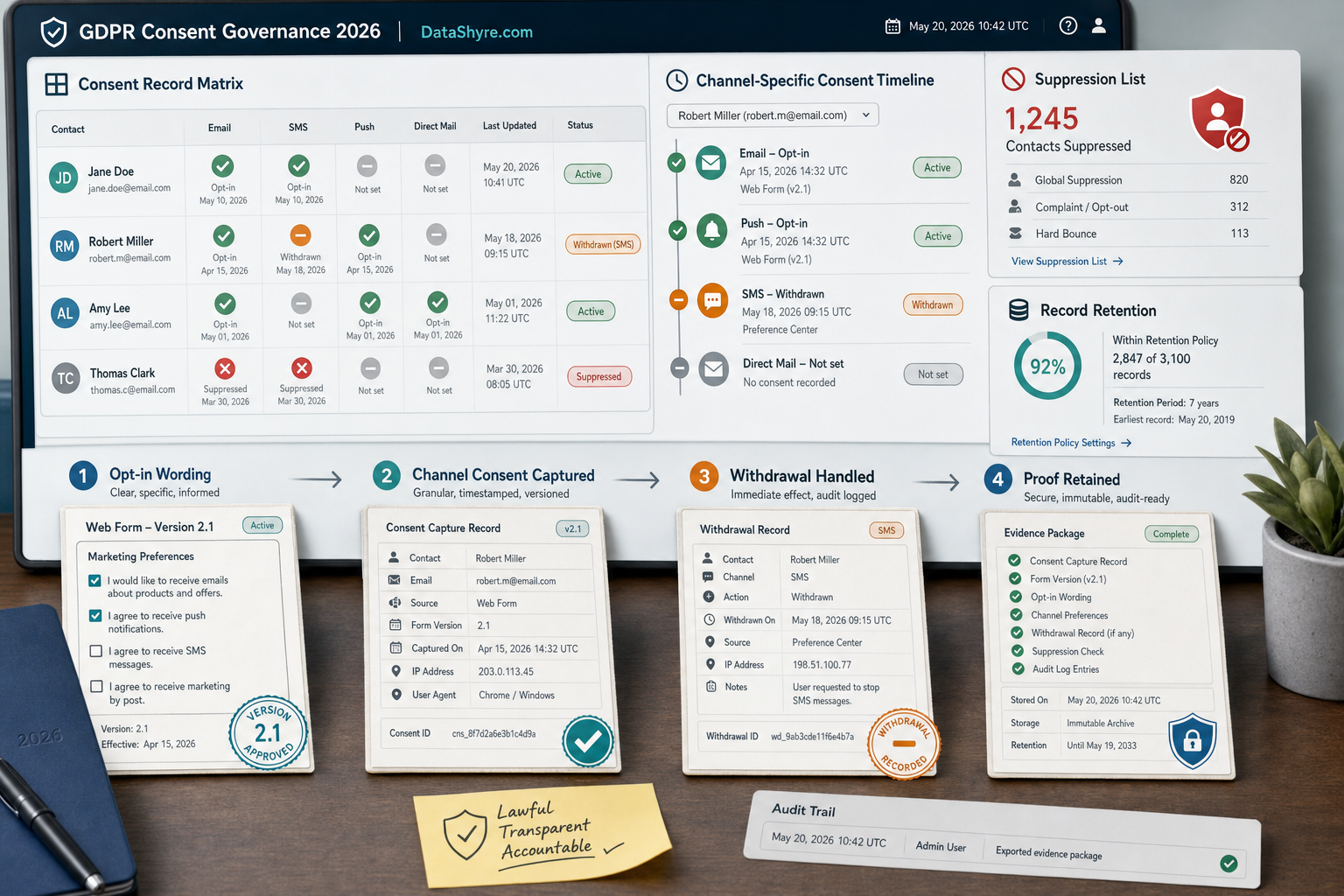
5. Keep proof that says more than yes or no
This is one of the most useful places to tighten gdpr marketing consent in 2026.
The European Commission still says the organization has to be able to demonstrate that the individual consented to the processing. That means a bare timestamp is not much of a record. You usually want enough evidence to reconstruct the event later:
- who collected the consent;
- when it was collected;
- which exact wording, version, and purpose the person saw;
- which channel the consent covered;
- what source captured it, such as form, checkout, event signup, import, or call recording workflow;
- whether the person later withdrew or changed the preference.
This proof question got even more concrete in France in 2026. CNIL’s current telemarketing guidance says consent for consumer marketing calls must be clear and active, valid for up to one year, and that proof of the consent must be retained for at least three years from collection on a durable medium that the consumer can access on request.
6. Do not copy one country’s exception into every market
This is the 2026 update many teams are still missing.
The ICO updated its electronic-mail marketing guidance on April 28, 2026 to explain a new charitable soft opt-in in PECR regulation 22(3A). That is a specific UK rule for a specific context. It does not mean every organization can skip consent for marketing emails.
France also moved in the opposite direction for many phone campaigns. CNIL says that from August 11, 2026, consumers generally cannot be telemarketed by phone unless they have given prior consent or the call relates to an existing contract, subject to the published exceptions.
This is why a cross-border gdpr marketing consent review should explicitly ask:
- which countries and subscriber types are in scope;
- whether the rule is a GDPR lawful-basis issue, an ePrivacy or PECR issue, or a national marketing rule;
- whether any exception is genuinely available;
- whether the exception applies only to one channel, one audience type, or one jurisdiction.
The broader your campaign footprint, the less safe generic consent wording becomes.
7. Treat measurement and tracking around the message as part of the same review
A lot of marketing teams still stop the review at Can we send the email?
The ICO’s current guidance says PECR’s electronic-mail rules apply to the message itself, but tracking pixels in emails may also trigger the separate storage-and-access rules. Its current storage-and-access guidance gives the same practical example: if a marketing email uses a tracking pixel that stores or accesses information on the user’s device, regulation 6 may apply to that processing too.
That matters because gdpr marketing consent often gets stretched to cover:
- the promotional message;
- the profiling that selects who gets it;
- the tracking pixels that measure opens or device data;
- the downstream audience-building or retargeting that follows.
Those do not always collapse into one permission question. If your team only validates the send and ignores the tracking around it, the consent model may still be incomplete.
A practical review sequence for this week
If I were auditing gdpr marketing consent on a live program today, I would do it in this order:
- identify the channel and country first;
- decide whether consent is truly the right GDPR basis or whether another basis is being confused with a channel rule;
- check that the ask is channel-specific and purpose-specific;
- remove any pre-ticked, bundled, or vague request patterns;
- test the unsubscribe, stop, or suppression path;
- inspect the evidence record, not just the front-end form;
- check any email-tracking or profiling layer wrapped around the campaign.
That sequence usually reveals more than a template library or legal memo does.
FAQ
Does GDPR marketing consent always require an unticked checkbox?
It requires a clear affirmative action and real choice. In many digital flows, an unticked dedicated checkbox is the safest and easiest pattern to defend.
Can legitimate interests ever apply to marketing under the GDPR?
Yes. The European Commission’s current guidance still says direct marketing can sometimes rely on legitimate interests. But separate electronic-marketing, phone-marketing, or national rules may still require prior consent for the channel you want to use.
Is one consent enough for email, SMS, calls, and tracking pixels?
Usually no. Current regulator guidance pushes toward channel-specific and purpose-specific analysis, and tracking around the message can create a separate compliance layer.
Bottom line
The useful way to think about gdpr marketing consent in 2026 is not as a single opt-in pattern.
It is a decision tree. First decide whether consent is the right lawful basis at all. Then check whether the channel has its own prior-permission rule. Then make the request specific, active, easy to withdraw, and backed by proof another team can still verify later.
Seen clearly, gdpr marketing consent is less about a pop-up and more about whether the site behaves honestly after the visitor makes a choice.
Sources
- European Commission, legal grounds for processing data: https://commission.europa.eu/law/law-topic/data-protection/information-business-and-organisations/legal-grounds-processing-data_en
- ICO, direct marketing guidance: https://ico.org.uk/for-organisations/direct-marketing-and-privacy-and-electronic-communications/direct-marketing-guidance/
- ICO, plan direct marketing: https://ico.org.uk/for-organisations/direct-marketing-and-privacy-and-electronic-communications/direct-marketing-guidance/plan-direct-marketing/
- ICO, guidance on direct marketing using electronic mail: https://ico.org.uk/for-organisations/direct-marketing-and-privacy-and-electronic-communications/guidance-on-direct-marketing-using-electronic-mail/
- ICO, guidance on storage and access technologies: https://ico.org.uk/for-organisations/direct-marketing-and-privacy-and-electronic-communications/guidance-on-the-use-of-storage-and-access-technologies/
- CNIL, electronic marketing by email, SMS-MMS, and autodialer: https://www.cnil.fr/fr/la-prospection-commerciale-par-courrier-electronique-sms-mms-et-automate-dappel
- CNIL, telemarketing by phone rules: https://www.cnil.fr/fr/prospection-commerciale-par-telephone-hors-automate-dappel-quelles-sont-les-regles